Factory Method
The Factory Method is a creational design pattern that defines an interface for creating objects in a super-class, while enabling subclasses to specify the exact type of objects that should be instantiated. In other words, it is a way to create objects without specifying the exact class to instantiate, but create an object of a specific class.
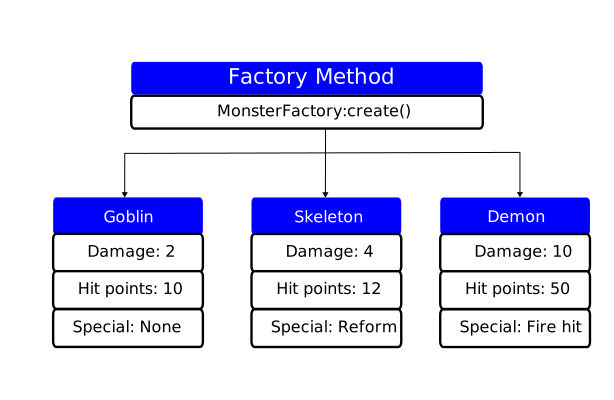
For the demo, let’s create a monster factory which will create a monster of a specific type for the abstract RPG game.
Monster class
First, let’s define our monster classes. There is abstract monster class and its subclasses: Goblin, Skeleton and Demon.
---@class Monster
---@field public name string
---@field public damage number
---@field public hp number
---@field public special string
local Monster = {}
Monster.__index = Monster

---@return Monster
function Monster:new(name, damage, hp, special)
    local t = {
        name = name,
        damage = damage,
        hp = hp,
        special = special
    }
    return setmetatable(t, self)
end

---@class Goblin: Monster
local Goblin = {}
---@return Goblin
function Goblin:new()
    return Monster:new("Goblin", 2, 10, "None") --[[@as Goblin]]
end

---@class Skeleton: Monster
local Skeleton = {}
---@return Skeleton
function Skeleton:new()
    return Monster:new("Skeleton", 4, 12, "Reform") --[[@as Skeleton]]
end

---@class Demon: Monster
local Demon = {}
---@return Demon
function Demon:new()
    return Monster:new("Demon", 10, 50, "Fire hit") --[[@as Demon]]
end
MonsterFactory class
Monster factory produces the monsters, depending on the type. In this pattern, you should not care about constructors of the monster, but just to create a monster by type. This method is invaluable when there are not too many monsters yet. But more if-elseif statements will be added for more types of monster you have. Here comes in handy another design pattern: Abstract factory.
---@class MonsterFactory
local MonsterFactory = {}

---@return MonsterFactory
function MonsterFactory:create(type)
    if type == "Goblin" then
        return Goblin:new()
    elseif type == "Skeleton" then
        return Skeleton:new()
    elseif type == "Demon" then
        return Demon:new()
    else
        error("unknown monster")
    end
end
Usage of MonsterFactory
local goblin = MonsterFactory:create("Goblin")
print(goblin.name, goblin.damage, goblin.hp, goblin.special)
local skelly = MonsterFactory:create("Skeleton")
print(skelly.name, skelly.damage, skelly.hp, skelly.special)
local demon = MonsterFactory:create("Demon")
print(demon.name, demon.damage, demon.hp, demon.special)

--[[
Goblin  2       10      None
Skeleton        4       12      Reform
Demon   10      50      Fire hit
--]]